Wall Street's 2026 Crash Warnings: Separating Fear From Financial Reality

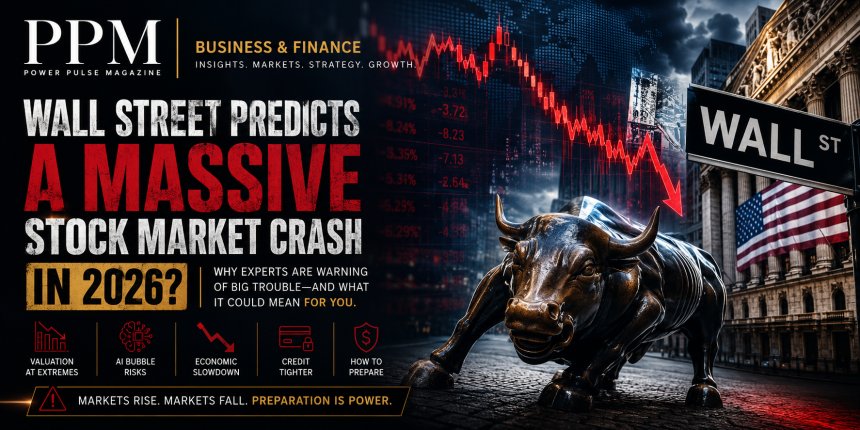


Wall Street's 2026 Crash Warnings: Separating Fear From Financial Reality
Why Some of the World's Most Respected Investors Believe the Market Is Becoming Increasingly Fragile—and What It Could Mean for the Economy
Category: Business & Finance
By: Maya Brooks & Lena Voss
Edited by: Todd Deck
Introduction
The words "stock market crash" immediately grab attention.
For many Americans, they bring back memories of the 2008 financial crisis, the dot-com collapse in 2000, the COVID-19 market panic in 2020, and even the infamous crash of 1929.
Now, similar headlines are appearing once again.
Several well-known Wall Street investors have warned that today's market may be entering one of its most speculative periods in decades. Their concerns range from soaring stock valuations and artificial intelligence enthusiasm to slowing economic growth and excessive investor optimism.
At the same time, many of the world's largest investment firms—including BlackRock, Goldman Sachs and Morgan Stanley—continue to forecast economic growth and higher corporate earnings, arguing that today's rally is supported by real profits rather than pure speculation.
So who's right?
The truth is more complicated than the headlines suggest.
Wall Street is not united in predicting a massive stock market crash in 2026.
Instead, investors are witnessing a growing divide between two competing views of the economy:
One side believes the market is entering dangerous bubble territory.
The other believes technological innovation—particularly artificial intelligence—is creating a new era of productivity that justifies today's higher valuations.
For consumers, business owners and investors, understanding both perspectives matters far more than reacting to sensational headlines.
Why Is Everyone Suddenly Talking About a Crash?
Financial markets move in cycles.
Periods of optimism often lead investors to pay increasingly higher prices for company shares. Eventually expectations become so optimistic that even strong earnings are no longer enough to satisfy investors.
When expectations become disconnected from reality, markets become vulnerable.
That doesn't guarantee a crash.
It simply means there's less room for disappointment.
Several respected market veterans believe today's environment resembles previous speculative periods that eventually ended with significant corrections.
The Bearish Case: Why Some Wall Street Veterans Are Sounding the Alarm
John Hussman: One of the Most Bearish Forecasts on Wall Street
Investment manager John Hussman has become one of the loudest voices warning about today's market.
His research focuses heavily on historical market valuations and long-term investor returns.
According to Hussman, current U.S. stock valuations rank among the most expensive in modern financial history.
He argues that investors are paying extraordinarily high prices relative to corporate fundamentals.
Based on historical valuation models, Hussman believes the S&P 500 could eventually experience declines ranging from approximately 55% to 75% over the completion of the current market cycle.
His forecast does not mean he expects the market to suddenly collapse overnight.
Instead, he argues that historically elevated valuations eventually return closer to long-term averages—and when they do, losses can be severe.
Critics point out that Hussman has maintained bearish views for years and has often warned of crashes long before they occurred.
Supporters argue that valuation models are designed to measure long-term risk rather than predict the exact timing of market declines.
Regardless of whether investors agree with his conclusions, his research highlights one undeniable reality:
Stocks are significantly more expensive today than their historical averages.
Jeremy Grantham: The AI Bubble Warning
Veteran investor Jeremy Grantham has issued similar concerns.
Grantham believes artificial intelligence is genuinely transformative.
However, he also believes investor excitement surrounding AI has become excessive.
History has shown that revolutionary technologies often produce investment bubbles.
The internet changed the world.
Railroads changed the world.
Electricity changed the world.
But many companies associated with those innovations still became wildly overpriced before their valuations eventually collapsed.
Grantham warns that AI could follow a similar pattern.
Artificial intelligence may reshape entire industries while many AI-related stocks still experience significant declines if investors become disappointed with future earnings.
This distinction is critical.
A revolutionary technology does not automatically guarantee that every company associated with it deserves its current stock price.
Is AI Creating a Bubble?
Artificial intelligence has become the dominant investment theme of the decade.
Companies worldwide are investing hundreds of billions of dollars into:
- AI infrastructure
- Semiconductor manufacturing
- Data centers
- Cloud computing
- Robotics
- Enterprise software
- Machine learning
- Energy infrastructure supporting AI computing
These investments have helped drive enormous gains across major technology companies.
Supporters argue this spending represents the beginning of a new industrial revolution.
Skeptics ask a different question:
Will these investments actually generate enough profits to justify today's valuations?
That question remains unanswered.
Many businesses are still experimenting with AI adoption.
Some companies are already seeing productivity gains.
Others continue investing heavily without clear financial returns.
If corporate profits fail to grow as quickly as investors expect, stock prices could adjust significantly—even if AI ultimately proves revolutionary.
Valuation Extremes: Why Expensive Markets Become More Fragile
One of the biggest concerns among bearish analysts isn't simply that stocks are expensive.
It's how expensive they've become.
Market valuation refers to how much investors are willing to pay for future corporate earnings.
During periods of optimism, investors often assume future profits will continue growing rapidly.
That optimism pushes valuations higher.
Eventually expectations become difficult to exceed.
When valuations reach historically elevated levels:
- Earnings surprises matter more.
- Disappointments become more costly.
- Market volatility usually increases.
- Investors become increasingly sensitive to negative news.
High valuations do not predict when markets will fall.
They simply reduce the margin for error.
The Hidden Risk: Market Concentration
Today's stock market appears broadly diversified.
In reality, a relatively small number of mega-cap technology companies account for a significant portion of major indexes like the S&P 500.
That creates concentration risk.
If those companies continue outperforming expectations, indexes can continue climbing.
However, if only a few of those companies disappoint investors, the broader market could decline much faster than many people expect.
This is one reason some analysts argue that today's market appears stronger than it actually is beneath the surface.
The Bull Case: Why Many Wall Street Firms Remain Optimistic
While bearish headlines receive enormous attention, most institutional forecasts are considerably more balanced.
Large investment firms generally point to several encouraging developments.
Corporate Earnings Remain Strong
Unlike previous speculative bubbles built largely on hype, today's largest technology companies generate enormous revenues and substantial cash flow.
Many AI leaders are profitable businesses with established customer bases.
That differs significantly from many dot-com companies during the late 1990s.
Productivity Improvements
Businesses continue adopting artificial intelligence across:
- Customer service
- Software development
- Healthcare
- Manufacturing
- Finance
- Logistics
- Marketing
- Scientific research
Supporters believe these productivity improvements could increase corporate profitability for years.
Economic Growth Continues
Although economic growth has moderated compared with previous years, the U.S. economy has continued expanding.
Employment remains relatively healthy.
Consumer spending has slowed but remains resilient.
Corporate earnings continue growing.
These factors support the argument that today's market is driven by real economic activity—not speculation alone.
Understanding the Negative Wealth Effect
Perhaps the greatest economic risk isn't simply falling stock prices.
It's something economists call the Wealth Effect.
The Wealth Effect describes how changes in household wealth influence consumer spending.
When retirement accounts, investment portfolios and personal wealth increase, consumers generally feel more financially secure.
They become more willing to:
- Buy homes
- Purchase vehicles
- Travel
- Dine out
- Upgrade electronics
- Spend on entertainment
- Invest in home renovations
That increased confidence supports businesses throughout the economy.
However, the opposite also happens.
The Negative Wealth Effect
If stock markets experience major declines, millions of Americans may suddenly feel less wealthy—even if their paychecks remain exactly the same.
Psychology becomes economics.
Families begin asking questions like:
"What if I lose my job?"
"What if my retirement account keeps falling?"
"What if the economy gets worse?"
Instead of spending, households begin protecting cash.
They delay vacations.
Cancel expensive purchases.
Reduce restaurant spending.
Postpone home renovations.
Avoid financing new vehicles.
Increase savings.
Pay down debt.
The result is known as the Negative Wealth Effect.
Why Consumer Spending Matters So Much
Consumer spending represents roughly two-thirds of the U.S. economy.
That means when households collectively spend less money, businesses earn less revenue.
Lower revenue often leads companies to:
- Slow hiring
- Reduce investment
- Delay expansion
- Cut expenses
If those trends become widespread, slower spending can eventually weaken the broader economy.
Importantly, the Wealth Effect does not affect everyone equally.
Many Americans own little or no stock.
Others have significant retirement savings invested through:
- 401(k) plans
- IRAs
- Pension funds
- Brokerage accounts
- Mutual funds
- Index funds
Higher-income households generally experience the strongest Wealth Effect because they own a larger share of financial assets.
However, even families without substantial investments may reduce spending if they become worried about job security or the overall economy.
Consumer confidence often influences economic activity almost as much as actual income.
Fear Can Become Self-Fulfilling
Financial markets are driven by numbers.
Economies are driven by people.
When enough households become cautious at the same time, businesses notice.
Lower spending reduces revenues.
Lower revenues reduce hiring.
Reduced hiring weakens consumer confidence even further.
This feedback loop can amplify an economic slowdown.
It does not guarantee a recession.
But it helps explain why economists closely monitor consumer confidence during periods of market stress.
Part 1 Summary
Today's market sits at the center of one of Wall Street's biggest debates.
Bearish investors warn that elevated valuations, AI speculation and concentrated technology leadership resemble previous market bubbles.
Bullish investors argue that strong corporate earnings, productivity gains and continued economic expansion justify higher valuations.
Neither side can predict the future with certainty.
What both sides agree on is this:
The higher markets climb, the more sensitive they become to unexpected disappointments.
Whether those disappointments ultimately lead to a routine correction, a prolonged bear market or something more severe remains one of the defining financial questions of 2026.
Coming in Part 2: What a major stock-market decline could mean for the U.S. economy, consumers, businesses, jobs, housing, credit markets and everyday Americans.
Sources
Government & Economic Data
- U.S. Bureau of Economic Analysis (BEA). Gross Domestic Product (GDP). https://www.bea.gov/data/gdp/gross-domestic-product
- U.S. Bureau of Labor Statistics (BLS). Employment Situation Reports. https://www.bls.gov/news.release/empsit.htm
- Federal Reserve Board. Monetary Policy & FOMC Statements. https://www.federalreserve.gov/monetarypolicy.htm
- Federal Reserve Bank of Philadelphia. Survey of Professional Forecasters. https://www.philadelphiafed.org/surveys-and-data/real-time-data-research/spf
- Congressional Budget Office (CBO). Economic Forecasts & Budget Outlook. https://www.cbo.gov
Wall Street & Investment Research
- Hussman Strategic Advisors. Weekly Market Commentaries. https://www.hussmanfunds.com/comment/
- BlackRock Investment Institute. Market Outlook & Investment Perspectives. https://www.blackrock.com
- Goldman Sachs Research. Global Market Outlook. https://www.goldmansachs.com/insights
- Morgan Stanley Wealth Management. Global Investment Committee Outlook. https://www.morganstanley.com/insights
- J.P. Morgan Asset Management. Guide to the Markets. https://am.jpmorgan.com
Financial & Economic Research
- International Monetary Fund (IMF). World Economic Outlook. https://www.imf.org
- Organisation for Economic Co-operation and Development (OECD). Economic Outlook. https://www.oecd.org/economic-outlook
- National Bureau of Economic Research (NBER). https://www.nber.org
- Federal Reserve Economic Data (FRED). https://fred.stlouisfed.org
Market Analysis
- Financial Times. Markets & Global Economy. https://www.ft.com
- The Wall Street Journal. Markets & Economy. https://www.wsj.com
- Bloomberg. Markets & Economics. https://www.bloomberg.com
- CNBC. Markets. https://www.cnbc.com/markets
- Morningstar Research. https://www.morningstar.com
Consumer & Personal Finance References
- Investopedia. Stock Market Crash, Wealth Effect & Market Definitions. https://www.investopedia.com
- SoFi Learn. Stock Market Education. https://www.sofi.com/learn
AI & Market Research
- arXiv. Enterprise AI Adoption and Corporate Productivity Research. https://arxiv.org
- McKinsey & Company. The Economic Potential of Generative AI. https://www.mckinsey.com
- PwC Global. AI Predictions & Economic Impact. https://www.pwc.com/ai
Historical Market Data
- S&P Dow Jones Indices. https://www.spglobal.com/spdji
- Nasdaq Market Data. https://www.nasdaq.com
- New York Stock Exchange (NYSE). https://www.nyse.com
Editorial Note
Power Pulse Magazine reviewed government publications, institutional market research, publicly available investment commentary, and historical financial data while preparing this feature. Forecasts represent the opinions of their respective analysts and institutions and should not be interpreted as guarantees of future market performance.

PPM Disclaimer
This article is published by Power Pulse Magazine (PPM) for educational, informational and editorial purposes only. It should not be considered financial, investment, tax, legal or professional advice.
Financial markets are inherently unpredictable, and forecasts discussed in this article represent the opinions and analyses of the individuals or institutions cited at the time of publication. Market conditions can change rapidly, and no forecast or projection should be interpreted as a guarantee of future performance.
Readers should conduct their own research and consult a qualified financial, tax or legal professional before making investment or financial decisions.
Power Pulse Magazine strives to present balanced reporting by referencing government agencies, established financial institutions, academic research and reputable news organizations. While every effort has been made to ensure accuracy, information may change after publication as new economic data becomes available.
AI-assisted research supported the editorial process, and all content was reviewed, fact-checked and edited by a human editor. Creative direction by Power Pulse Magazine.
© 2026 Power Pulse Magazine. All rights reserved. Redistribution or reproduction of this article, in whole or in part, without written permission is prohibited.
Share
What's Your Reaction?
 Like
1
Like
1
 Dislike
0
Dislike
0
 Love
0
Love
0
 Funny
0
Funny
0
 Angry
0
Angry
0
 Sad
0
Sad
0
 Wow
0
Wow
0